

Owner: Greg McComas
Location: Mexico
Era: 1980's-Present
Reporting Mark: LFGR, GRB


AVAILABLE LFGR EQUIPMENT
PC&F 40' Boxcar - Pre-Order now through Rapido or a Rapido Dealer

About Línea Ferrocarril Golfo y Río Bravo (LFGR)
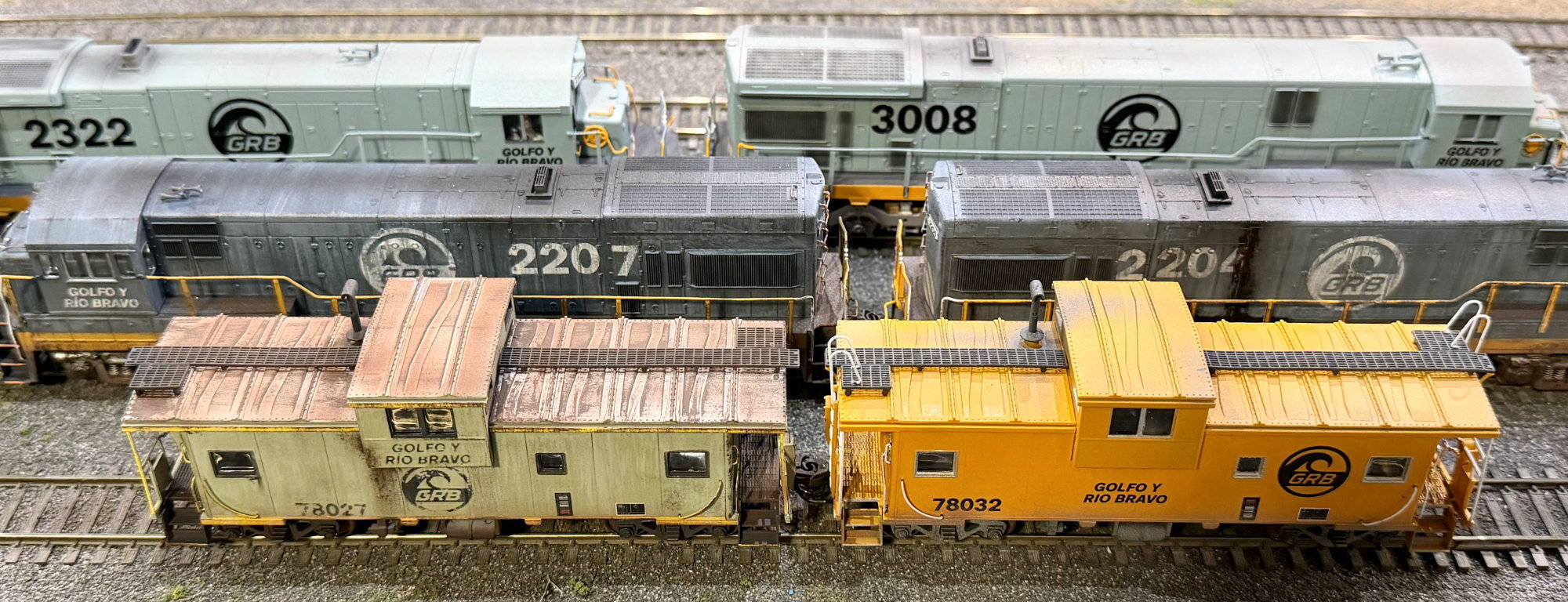
“La Costera del Golfo”
Overview
The history of the Línea Ferrocarril Gulfo y Río Bravo unfolds as a cross border story of ambition, regional identity, and survival through multiple eras of Mexican rail policy. Its origins trace back to the early 1900s, when a consortium of businessmen from Texas and northeastern Mexico sought to create a rail corridor linking the fertile plains of Tamaulipas with the Gulf ports. Their goal was simple but bold: move sugar, grain, cattle, and manufactured goods efficiently between Matamoros, the interior towns, and the emerging industrial coastline. The line grew in segments, eventually reaching Altamira, and later extending south toward Tuxpan and Poza Rica, forming a coastal artery that locals came to call La Costera del Golfo.
Through the mid 20th century, the railroad remained privately operated, weathering hurricanes, economic downturns, and competition from trucking. Its independence ended in 1987, when the Mexican government consolidated numerous regional lines into the federalized system. While much of the GRB’s infrastructure and operations were absorbed, the line retained a surprising amount of its branding, practices, and local management, thanks to strong political support in Tamaulipas and the railroad’s importance to agricultural and petrochemical shippers. Crews continued to refer to it by its initials, and its locomotives—patched but recognizable—remained a familiar sight along the Gulf.
In 1995, during the wave of privatization and restructuring that reshaped Mexico’s rail network, the line was petitioned off as a standalone concession. A mid sized holding company operated it for nearly three decades, investing modestly in track upgrades and secondhand locomotives while preserving the railroad’s regional character. The system’s mix of sugar cane traffic, cement, chemicals, and agricultural products kept it profitable enough to survive, even as larger carriers modernized around it.
A major turning point arrived in 2015, when MAC Transportation de México won the concession. The new owner launched a modernization program, rebuilt key yards, and rebranded the railroad as Ferrocarril Noreste del Golfo, adopting the slogan “Ruta de las Palmas” to reflect the coastal identity and the palm lined landscapes of Tamaulipas and Veracruz. While the name changed, the spirit of the old GYRB remains embedded in the culture, the communities it serves, and the winding coastal mainline that has defined the region for more than a century.


Operations
The Línea Ferrocarril Golfo y Río Bravo, known by crews and coastal communities as La Costera del Golfo, is a freelanced regional railroad running along the warm, humid curve of the Gulf of Mexico. Its territory stretches from the busy border city of Matamoros down to the industrial port complex at Altamira, passing through sugar‑cane country, wetlands, and clusters of small agricultural towns. The line’s identity is shaped by its coastal environment—salt‑laden breezes, sudden tropical storms, and long, flat horizons that make operations both scenic and demanding.
Freight traffic on La Costera del Golfo centers on sugar‑cane products, cement, chemicals, and agricultural commodities. To move these dense, high‑volume loads efficiently, the railroad relies on its signature fleet of 100‑ton, 40‑foot high‑cube boxcars, painted in bold coastal colors and marked with the stylized GRB emblem. Compact but heavy‑duty, these cars are ideal for the short hauls between processing plants, refineries, and the port, where quick turnarounds matter more than long‑distance capacity.
Operations along the line blend industrial work with stretches of quiet rural running. Northbound trains often leave Altamira at dawn, rumbling past petrochemical complexes before entering the agricultural belt. Southbound freights grow heavier as they accumulate sugar‑cane byproducts, bagged cement, and chemical loads destined for export. Dispatching is known for its tight scheduling; storms rolling in from the Gulf can disrupt operations quickly, so trains are often run in compact, carefully timed windows to stay ahead of the weather.

Despite its modest size, the Línea Ferrocarril Golfo y Río Bravo has earned a reputation for reliability and regional pride. Crews are closely tied to the communities along the route, and the railroad’s locomotives—faded by sun and salt air—are familiar sights near cane fields and coastal marshes. The blend of heavy industry, agricultural heritage, and Gulf‑coast atmosphere makes the LFGR a compelling freelanced railroad, rich with operational variety and visual character.
The GRB’s mainline follows a north–south arc along the Gulf of Mexico, beginning at Matamoros, a border gateway with sugar mills, maquila warehouses, and agricultural industries. South of there, Jiménez serves as the junction for the Soto la Marina Branch. Victoria forms the midpoint of the system, with shared trackage rights and a cluster of cement and chemical industries. Altamira anchors the central district as a major port and petrochemical hub, while the Pánuco River crossing creates a signature operational choke point on the run toward Tuxpan de Rodríguez Cano and Poza Rica. This spine supports long‑haul chemical trains, agricultural traffic, cement movements, and port‑related freight.
The Northern District, from Matamoros to Jiménez, remains the agricultural and border‑commerce heart of the railroad. Key customers include Ingenio Río Bravo, AgroTrans Cooperative, and maquila supply warehouses. Jiménez functions as the operational pivot point, with a small yard for staging locals and transferring loads between the mainline and the Soto la Marina Branch. That branch serves GranCem La Pesca’s cement complex, AluMarina Metals’ aluminum facility, and the Soto la Marina Agricultural Cooperative, ending at La Pesca where the cement plant dominates the skyline and generates steady unit‑train traffic.
The Central District, running from Jiménez through Victoria to Altamira, includes shared trackage with Ferromex and the Aldama Branch. Major industries include Cemento del Bravo, Química Sierra Madre, and Empaque del Valle. The Aldama Branch adds short‑haul, high‑frequency service to grain processors, fertilizer distributors, and Bravo Plastics.
The Southern Coastal District, stretching from Altamira to Tuxpan and Poza Rica, forms the railroad’s industrial powerhouse. It includes the port of Altamira, the Pánuco River crossing, and a long coastal run serving Petroquímica Altamira, Terminal de Graneles Agrícolas, port warehousing, Tuxpan fuel terminals, and the Poza Rica industrial zone. This district handles the heaviest trains on the system, including long chemical drags, cement blocks, and port‑bound agricultural loads.

About the PC&F LFGR Boxcar
The 1977-built 100 ton, 40 foot high cube boxcars became even more central to the identity of the Línea Ferrocarril Gulfo y Río Bravo once the railroad expanded its commercial reach beyond the Gulf Coast and into cross border service. Originally purchased to move dense commodities between sugar mills, agricultural processors, chemical plants, and the port at Altamira, these compact heavy duty cars soon proved ideal for a new opportunity: short haul, high turnover traffic into the United States.
How the boxcars entered cross border service
By the early 1980s, shippers in Matamoros and Brownsville were looking for reliable equipment to move palletized sugar products, bagged cement, processed feed, and packaged agricultural goods northward. The GYRB’s modern 40-footers—strong enough for 100 ton loads yet short enough for tight industrial trackage—were a perfect fit. Their durability and ease of loading made them popular with U.S. consignees, and the railroad began assigning dedicated blocks of these cars to cross border manifests. The cars regularly crossed the international bridge at Matamoros–Brownsville, where they were interchanged with U.S. short lines and Class I carriers.
Operational impact on the railroad
The move northward gave the boxcars a dual identity. South of the border, they continued to serve sugar cane processors, cement plants, and chemical facilities along the Gulf. North of the border, they became known for their reliability in short cycle service, often turning back to Mexico within days. Their bold coastal paint schemes and stylized GRB emblem made them instantly recognizable in yards across South Texas. Even after the railroad was partially folded into the federal system in 1987, many of these cars retained their original colors with patched reporting marks, a visual reminder of the line’s independence.
Their role through privatization and into the modern era
During the 1995 concession period, the cross border service expanded further as maquila related freight grew. The 1977 boxcars became the backbone of this traffic, carrying everything from processed foods to industrial inputs. When MAC Transportation de México took over in 2023 and rebranded the railroad as Ferrocarril Noreste del Gulfo – Ruta de las Palmas, the surviving cars were selectively rebuilt for continued international service. A portion received modernized interiors and upgraded brake systems to meet U.S. interchange standards, while a few were restored in heritage GYRB colors as a nod to the line’s century long history.
These boxcars now represent a rare continuity across eras—private ownership, federalization, privatization, and modern concession—while still rolling across the border they first reached more than forty years ago.

